


I am looking for:
Law Current to: July 3, 2025
SPER’s Enforcement Powers
The registrar holds several powers under Part 5 of the State Penalties Enforcement Act 1999 to enforce unpaid amounts. These powers can only be used when an enforcement order has been issued and your client has not taken a relevant action to respond to the order within 28 days. To enforce amounts owing, SPER can:
- order the redirection of money to SPER through a Fine Collection Notice
- suspend a driver licence
- issue an ‘enforcement warrant’ which allows SPER to:
- immobilise a vehicle
- seize and sell property
- register an interest in property
- imprison the enforcement debtor
What Enforcement Powers Does SPER Have?
Fine Collection Notices
Section 75 of the SPE Act gives the registrar the power to issue a Fine Collection Notice for any unpaid amounts. Once an Fine Collection Notice is issued, the amount to be paid to SPER is increased to include a civil enforcement fee: SPE Act s 75(3). As of June 2025, the civil enforcement fee was $123.65: SPE Regulation 2014 s 23.
A Fine Collection Notice can require the payment of unpaid amounts in various ways, including by compelling:
- an employer to redirect a person’s earnings or salary to SPER;
- a third party (eg casinos, insurance companies, trustees of an inheritance and the Queensland Police Service) to redirect all or part of a debt owed to the debtor to SPER; or
- a financial institution to make a payment or regular redirections to SPER from the debtor’s bank account, or an account held on the debtor’s behalf;
until the amount is paid: SPE Act s 75 (2).
SPER will issue the Fine Collection Notice to the financial institution, employer or third party. SPER does not have to go to the court to issue a Fine Collection Notice, and the decision to issue a Fine Collection Notice cannot be appealed by your client: However, a debtor can apply to have a Fine Collection Notice reviewed, varied, or suspended: SPE Act s 77.
SPER must give a copy of the Fine Collection Notice to the debtor as soon as practical after it is issued: SPE Act s 78.
Limits on Redirection Amounts
There are limits on the amounts that can be redirected or paid under a Fine Collection Notice.
An employer should not deduct an amount from your client’s earnings which would reduce their earnings to below the protected earnings amount: SPE Act s 82(2).
A financial institution must not deduct an amount from your client’s bank account if the deduction would cause the account to be overdrawn or result in the total balance of all the accounts your client holds with the financial institution to be less than a protected amount: SPE Act ss 102, 103C. The relevant protected amount for 1 January 2024 to 31 December 2024 is $514.50 per week: SPE Regulation 2014 s 20B.
You can calculate the protected earnings amount by applying the protected earnings rate (prescribed under the Child Support (Registration and Collection) Act 1988 (Cth)) to the relevant period for which earnings are paid: SPE Act sch 2.
Suspension of Driver Licence
SPER can suspend a person’s driver licence if it is satisfied that the person is not taking steps to pay or otherwise discharge the amount owing: SPE Act s 104(2).
If your client is charged with unlicensed driving during the period of suspension by SPER, a court is obligated to disqualify them from holding or obtaining a driver licence for at least one month but less than six months: Transport Operations (Road Use Management) Act 1995 (Qld) s 78(3)(f). They will also likely receive a further fine for unlicenced driving.
Licence Suspension Process

Imprisonment
SPER is empowered to issue an arrest and imprisonment warrant only when it is satisfied that the unpaid amount cannot be satisfied in any other way by your client. The arrest and imprisonment warrant stops having effect if the unpaid amount is paid before your client is imprisoned: SPE Act s 119.
This power is rarely used by SPER.
People experiencing hardship and marginalisation may not have received correspondence from SPER, including notices and enforcement warrants. The SPER Online Portal includes any details of enforcement action.
In practice, it is useful to check the SPER Online Portal with a client to confirm if any enforcement action has been taken or is about to be taken.
Enforcement Warrants
The registrar can issue an enforcement warrant empowering SPER to:
- Immobilise a vehicle (referred to as an ’immobilisation warrant’)
- Seize and sell property
- Register an interest in property.
Once an enforcement warrant is issued, the amount owing is increased to include a civil enforcement fee. As of June 2025, the civil enforcement fee was $123.65: SPE Regulation 2014 s 23.
Powers of enforcement officers when executing enforcement warrants
An enforcement officer may, at any reasonable time of the day or night, enter any premises stated in an enforcement warrant to execute it: SPE Act s 70(1).
An officer seeking to enforce a warrant can only enter residential parts of a premise if the occupier has consented or their entry is authorised by the warrant: SPE Act ss 70(2), 108I(2).
SPER may apply to a Magistrate or Justice of the Peace for a search warrant, where it reasonably believes there may be property mentioned in a warrant at the premises: SPE Act ss 71(1), 108L.
An enforcement warrant can be to seize and sell a vehicle which is subject to an immobilisation warrant. However, the vehicle cannot be seized and sold while it is immobilised under the warrant: SPE Act ss 63(6)-(7).
SPER is entitled to tow seized motor vehicles to a holding yard: SPE Act s 73B.
Immobilise a Vehicle
Section 108 of the SPE Act authorises SPER to take steps to take steps to immobilise a vehicle, where the amount owing under an enforcement order is $5,000 or more: see also SPE Regulation 2014 s 21.
An immobilisation warrant can be issued without further notice to the debtor and without their consent. Vehicles are commonly immobilised by attaching a wheel clamp.
An immobilisation warrant will only be issued by SPER when:
- the vehicle to be immobilised is a motor vehicle with wheels or a trailer, including caravans, built to be attached to a motor vehicle with wheels
- your client is the sole registered operator of the vehicle
- your client currently owes SPER $5,000 or more in outstanding fines or infringements
- SPER is satisfied that your client is not taking steps to discharge the unpaid amount
- it is not possible or appropriate for another form of enforcement action to be taken by SPER
- another form of enforcement action has been attempted by SPER unsuccessfully.
Immobilisation can occur in a public place, at your client’s residence, or at your client’s place of business. If the vehicle is at any other premises, SPER requires the consent of the occupier of the premises: SPE Act s 108H.
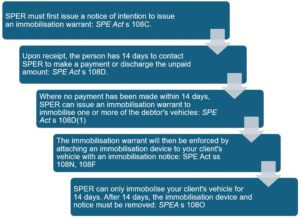
Ending the immobilisation period early
SPER is required to end the immobilisation early if:
- It is satisfied that the unpaid amount has been paid or is being discharged; or
- The immobilised vehicle is impeding public use or safety of a place.
SPER can also end the immobilisation early if it is satisfied that the immobilising device will otherwise cause severe or unusual hardship to your client, their family, or another person who uses the vehicle but has no capacity to ensure the amount owing is paid.
Seize and Sell Property
SPER may issue an enforcement warrant to seize and sell real and personal property in which a person has a legal or beneficial interest: SPE Act s 63(2)(a).
Property seized by SPER cannot be sold if, at any time at or before the sale, your client pays the amount owing: SPE Act s 73D.
Your client is entitled to any proceeds left over from the sale of property after:
- SPER has recouped the unpaid amount and any enforcement costs; and
- Third parties with a registered charge over the property have recouped any amounts owing to them: SPE Act s 73J.
Register an Interest in Property
SPER may issue an enforcement warrant to impose a charge on your client’s property: SPE Act s 63(2)(b). This charge entitles SPER to the same remedies as if the charge had been made in SPER’s favour by your client. However, SPER must wait 21 days from the date of the warrant being served on your client (and, for interests in managed investments schemes or securities, the person who issued or administers the interests or securities), before seeking to obtain such remedies: SPE Act s 66
Summary of available enforcement action and options for resolution
Enforcement Action
| Enforcement Action | Infringement Notice | Court-order Fine | Victims of crime assistance (VOCA) | Court-ordered compensation or restitution | Offender levy |
|---|---|---|---|---|---|
| Can SPER suspend your driver licence? (ss 104-108 SPE Act) | Yes | Yes | Yes | Yes | Yes |
| Can SPER issue a fine collection notice? (ss 75-104, SPER Act) | Yes | Yes | Yes | Yes | Yes |
| Can SPER issue a vehicle immobilisation order? (ss 108A-108Z, SPER Act) | Yes | Yes | Yes | Yes | Yes |
| Can SPER issue an enforcement warrant to: • seize and sell your real and personal property; or • impose a charge or register an interest in specified property? (ss 63-74, SPER Act) | Yes | Yes | Yes | Yes | Yes |
| Can SPER arrest and imprison you? (ss 52, 119 and 146, SPER Act) | Yes | Yes | No. See s 193(3) and (6), Victims of Crime Assistance Act 2009 (Qld). | Yes. A sentencing court may also make an order that an offender is to be imprisoned if they fail to comply with an order for restitution or compensation: ss 36 and 37, Penalties and Sentences Act 1992 (Qld). | No. See s 179F(3) and (7), Penalties and Sentences Act 1992. |
Options for Resolution
| Resolution Options | Infringement Notice | Court-order Fine | Victims of crime assistance (VOCA) | Court-ordered compensation or restitution | Offender levy |
|---|---|---|---|---|---|
| Can you repay your fines under a reduced instalment plan? | Yes. | Yes. | Yes. | Yes. | Yes. |
| Can you work off your debt through unpaid community service (a work and development order)? | Yes. | Yes. | Yes. Although fine option orders, which preceded the introduction of Work and Development Orders, could not be completed to pay VOCA debts: See s 193(3) and (6), Victims of Crime Assistance Act 2009 (Qld). | No. See s 32I SPE Act. | Yes. |